O VI Emission from the CGM
What are the properties of O VI-bright gas?
We are on the cusp of a revolution in circumgalactic medium observations: new technology has recently been developed that improves the sensitivity of UV telescopes so significantly that small instruments, like CubeSats, will soon be able to detect UV emission from the CGM of nearby galaxies. Aspera is one of the first such small telescopes to be developed and will be launched in 2026, but several more are in the pipeline. With extraordinary new data coming soon, we must use simulations to understand how to interpret this new data.
In a recent paper, "Figuring Out Gas & Galaxies In Enzo (FOGGIE) XI: Circumgalactic O VI Emission Traces Clumpy Inflowing Recycled Gas" (here), I used the FOGGIE simulations to generate predictions of O VI emission from the CGM of Milky Way-like galaxies. O VI is highly ionized, likely tracing warm gas, and has one of the strongest atomic transitions that we can detect in the UV. Combined with the fact that oxygen is one of the most prevalent elements, O VI is detected in absorption nearly ubiquitously in the CGM of many galaxies. Absorption gives only 1-dimensional information along the line of sight, so being able to map O VI in emission in 2D will provide much more information about how widespread this gas this.
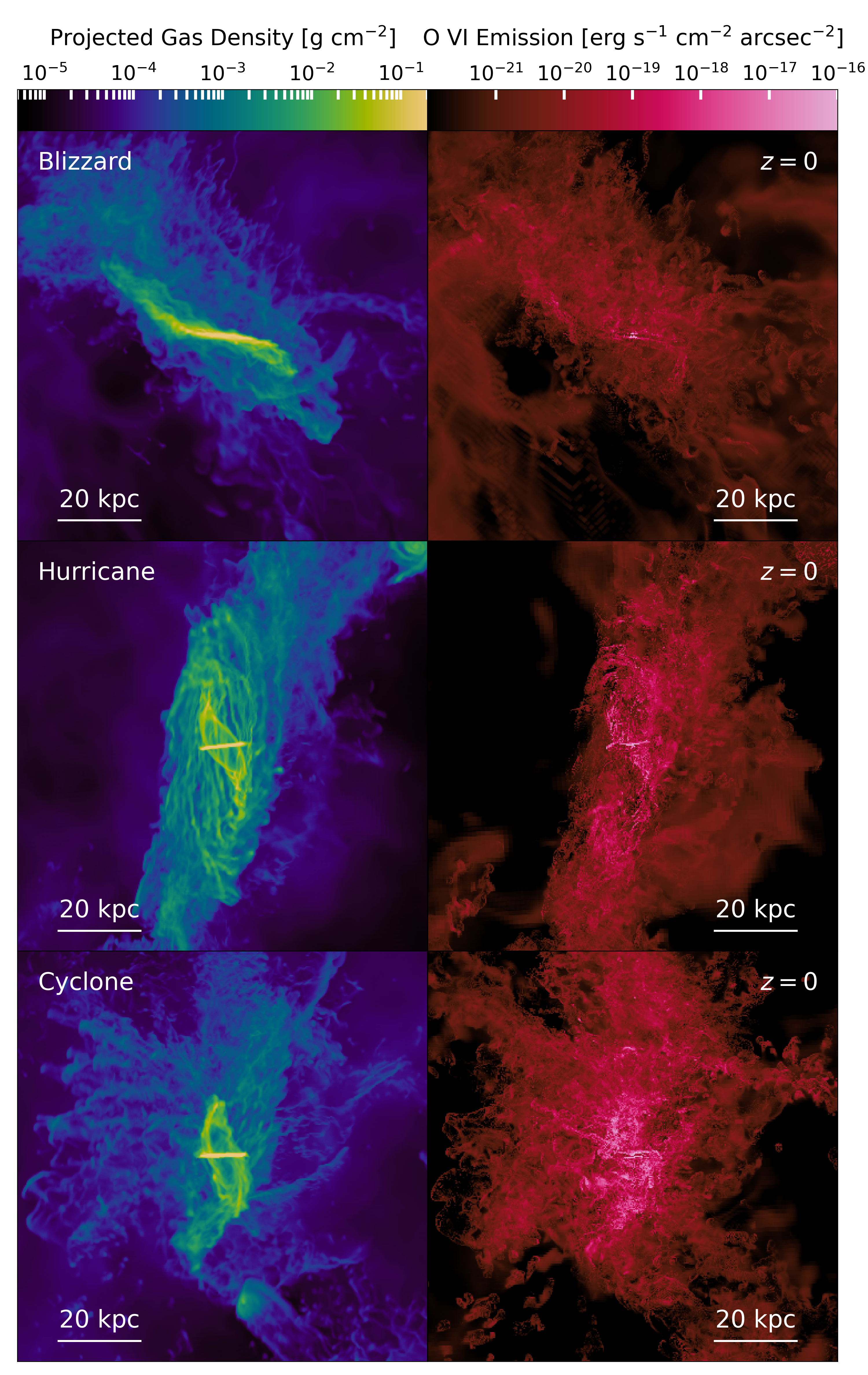
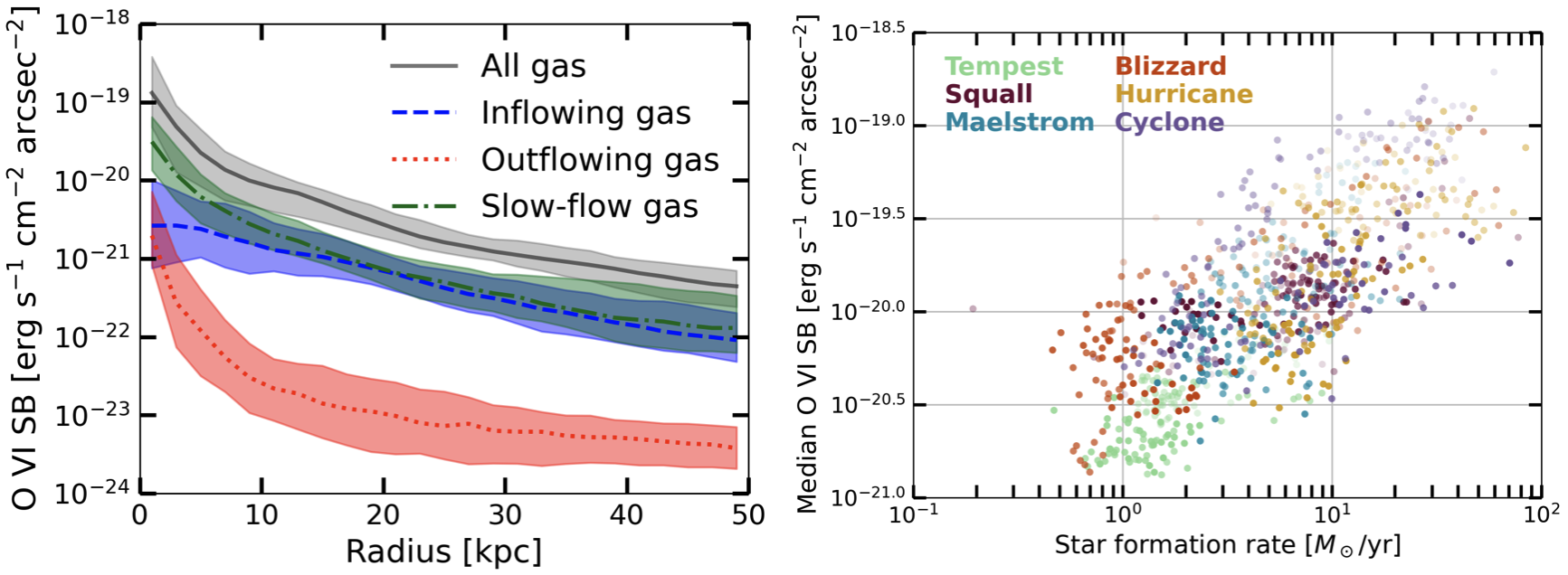
I found that O VI emission is brightest in small, structured regions close to galaxies, where the gas is both warm enough for O VI and dense enough for strong emission (emission scales as density-squared, so it tends to trace denser gas phases). These structures appear "bubble-like" and could be highlighting warm gas shells surrounding colder gas. I also found the brightest O VI is also predominantly inflowing onto the galaxy and galaxies with higher star formation rates have brighter and more wide-spread O VI emission in their CGMs. This suggests that O VI is tracing a clumpy galactic fountain, where feedback from star formation enriches the CGM with metals, including oxygen, and this material later condenses into dense gas that falls back onto the galaxy and glows in O VI as it does so.
When the first data from new CGM emission instruments begin rolling in, we know that we will be witnessing galactic fountains at work!
